What is BIOS?
Before your computer's operating system displays your desktop, and
the programs you've installed, there's a vital component running
behind the scenes that's responsible for starting the boot
process—the BIOS. Although most users rarely pay attention to it,
the BIOS plays a central role in starting your computer, testing
the hardware components, and preparing your computer to load the
operating system.
The BIOS is actually a component built into the computer's
motherboard , whose job is to provide the system with the initial
instructions needed to turn on the computer and begin the boot
process. Immediately after pressing the power button, the BIOS
goes into action and performs a series of tests known as POST
(Power-On Self-Test), during which it checks that key hardware
components such as RAM , storage drives - NVMe, SSD, HDD, graphics
card, keyboard and mouse are working properly.
After the tests are successfully completed, the BIOS searches for
a healthy operating system on the computer's drives and transfers
control to it, so that it can continue the boot process. In
addition, the BIOS includes basic device drivers that allow the
computer to communicate with the hardware components, as well as a
settings interface through which you can change various options
such as the boot order, the time, and other settings related to
the hardware components installed in the computer.
Why is the BIOS so important?
Without the BIOS, the computer would not be able to start the boot
process and function properly. It is responsible for testing the
hardware components at startup, initializing the essential
components, and loading the operating system, thus acting as a
kind of bridge between the hardware and software, allowing them to
communicate with each other.
Furthermore, the BIOS gives the user access to a variety of system
settings that allow the computer to be customized to suit
different needs, and in some cases even includes security
mechanisms, such as password protection of the boot process.
Therefore, although it runs in the background and is almost
imperceptible during daily use, the BIOS is a fundamental and
essential part of any computer.
Some of the actions that can be performed using the BIOS include:
Setting the boot order
Setting voltages of hardware components installed in a
computer
Setting the date and time on your computer
Changing processor settings
Change how the power button works
Enable or disable the built-in sound card
Changing RAM settings and checking the amount of memory
installed on your computer
Setting or removing a BIOS password
BIOS types
There are two main types of BIOS you might encounter on computers:
Legacy BIOS and UEFI (Unified Extensible Firmware Interface). Both
are responsible for the computer's boot process and the initial
communication between the hardware components and the operating
system, but they differ in how they work and the capabilities they
offer.
Legacy BIOS
The traditional firmware interface that has existed in computers
for many years. It acts as an intermediary between the hardware
and the operating system, performing the initial testing and
initialization of the computer's components and then transferring
control to the operating system. The Legacy BIOS interface is
relatively simple and based primarily on text menus, with more
limited options for customization and hardware management.
UEFI
The modern interface designed to replace the Legacy BIOS and solve
some of the problems it had. UEFI offers an advanced and more
user-friendly graphical interface that includes mouse support, so
it is easier to navigate through the settings and make changes. In
addition to ease of use, UEFI supports more modern technologies
and provides advanced capabilities in booting and hardware
management and security. Therefore, it has become the common
standard in new computers.
In practice, when you enter the "BIOS" settings on a modern
computer today, in most cases it is actually the UEFI interface.
Although the term BIOS is still commonly used, UEFI is the current
interface that handles the boot process and allows you to
configure the computer's components.
How do you enter BIOS?
To enter the BIOS, you must turn on or reboot your desktop or
laptop computer, and during the first few seconds of the startup
process, look for a message on the screen that displays the key
you need to press to enter the BIOS.
Most computers will display a message that says "Press F2 to enter
BIOS" or "Press DEL to enter Setup", but the correct key varies
depending on the manufacturer and model of the motherboard.
Once the message appears, quickly press the appropriate key,
sometimes several times in a row, until the BIOS interface
appears. If the operating system boots before you can enter the
BIOS, you will need to restart your computer and try again.
The bottom line
The BIOS is a vital component of the boot process, connecting the
hardware to the operating system and allowing your computer to
function properly. Although it runs in the background and is not
always noticeable, understanding how it works and the settings it
offers can help you improve performance, troubleshoot problems,
and maintain a secure and stable system.
BIOS Questions and Answers
What does BIOS mean?
The letters BIOS are an acronym for Basic Input/Output System.
That is, a basic input/output system.
Is BIOS software or hardware?
The BIOS is software, or more precisely firmware, but it is stored
on a component built into the motherboard.
What is Secure Boot in BIOS settings?
Secure Boot is a security mechanism that ensures that only
software and operating systems with a trusted digital signature
can run during the boot process. It aims to protect the computer
from boot-level malware and attempts to install an unauthorized
operating system.
Is the BIOS completely secure?
No. Although the BIOS is very important to the boot process and
system operation, it can also be a target for malware and security
exploits. Therefore, it is important to update it frequently and
use available security features like Secure Boot.
Can BIOS settings affect computer performance?
Yes. Certain settings, such as processor frequency , RAM timings,
and power management settings, can affect your computer's
performance. However, changing settings without knowledge and
experience can cause system instability or boot problems.
Is the BIOS in RAM or ROM?
Traditionally, the BIOS was stored in ROM. In modern computers, it
is usually stored in flash memory, which allows the information to
be retained even when the computer is turned off and allows the
firmware to be updated when necessary.
Is the BIOS the same on all computers?
No. Although the basic function of the BIOS is similar on all
computers, the boot process, hardware testing, operating system
loading, interface, and available options vary depending on the
motherboard manufacturer and computer model.
BIOS
settings The
most recommended for Linux systems are
switching to UEFI mode ,
changing the disk controller to AHCI mode and
disabling the Fast Boot feature These
settings ensure full hardware compatibility, optimal storage
performance, and stability when running the system.
You
can enter the BIOS settings by restarting the computer and quickly
pressing the dedicated key (usually
F2). , F12
, or
DEL ), or directly from the Linux terminal using the
command: systemctl
reboot --firmware-setup.
Below
is a summary of the recommended settings and an explanation for
them:
| Option
in BIOS |
Recommended
setting |
Explanation
and importance for Linux |
| Boot
Mode / Sequence |
UEFI
|
Compatible
with modern partition management (GPT). It is
recommended to abandon the old Legacy/CSM mode. |
| SATA
Operation / Storage |
AHCI
|
Essential
for Linux to recognize SSD/HDD drives correctly. Intel
RAID/RST mode should be avoided as it causes recognition
issues. |
| Fast
Boot / Quick Boot |
Disabled
|
Prevents
the computer from "skipping" critical hardware detection
and allows clean access to the Boot menu. |
| Secure
Boot |
Disabled
(or
Other OS) ) |
Many
distributions (like Ubuntu) support Secure Boot, but
more advanced distributions require it to be disabled in
order to load third-party drivers. |
| Virtualization
(VT-x / AMD-V) |
Enabled
|
Required
if you plan to run virtual machines (KVM, VirtualBox,
Docker). |
What is RAM?
RAM ( Acronym for Random Access Memory) is the short-term memory of a computer, which temporarily stores the data and programs that the device is currently using.
How does it work?
Temporary desktop: You can think of RAM as a physical desktop. The hard disk (drive) is like the cabinet where you store all your books and files, but when you want to work on a particular book, you take it out and place it open on the desk so you can immediately look at it.
Quick access: The processor (CPU) can access any data in RAM extremely quickly and directly, much faster than reading the data from the hard drive or other storage devices.
Volatile memory: RAM needs electricity to remember things. As soon as you turn off or lift the power switch (turn off the computer), all the information in RAM is completely erased.
Why is RAM important?
Multitasking: The more RAM you have, the more programs, browser windows, and apps you can run simultaneously without the device starting to slow down or freeze.
Response speed: An adequate amount of memory ensures smooth and fast transition between the different tasks the computer performs.
Common RAM Capacities and Uses
4GB: Handles basic tasks like writing emails, viewing documents, and light web browsing.
8GB: Works well for office work, and everyday multitasking.
16GB: Serves as the current standard and sweet spot for general productivity.
24GB & 48GB: Provides intermediate step-up options found in specific laptops and handheld gaming devices.
32GB: Ideal for heavy multitasking, streaming while gaming, and professional video editing.
64GB and above: Reserved for extreme workloads, 3D rendering, virtual machines, and high-end servers.
It is important to ensure that your computer has enough RAM to allow smooth use, meaning no less than 8GB.
What are the main types of drives for storing data on a computer?
They are a mechanical hard drive (HDD), a solid-state drive (SSD), and an ultra-fast NVMe drive.
Modern computing relies heavily on internal storage in a computer to manage data, run applications, and support system operations. Whether you're building a new system, upgrading an old one, or optimizing performance, understanding the different types of internal storage is essential.
Internal storage refers to any data storage device that is installed inside a computer , such as a hard disk drive (HDD) , solid-state drive (SSD) , NVMe drive , or hybrid drive (SSHD). Each type serves a unique purpose and varies in speed , durability , cost , and capacity .
Hard disk drives (HDD)
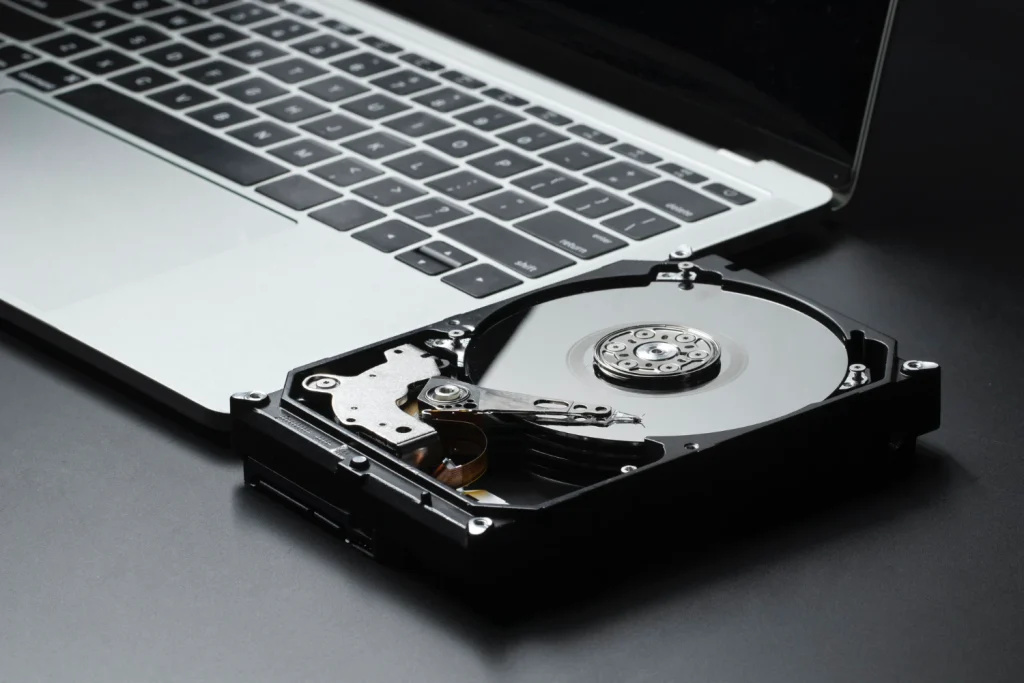
Hard disk drives (HDDs) are one of the oldest and most common forms of internal computer storage. Relying on magnetic storage technology, hard drives use spinning platters and a mechanical read/write head to store and retrieve data. Although newer technologies such as solid-state drives (SSDs) have gained attention for their speed, they remain a popular choice due to their affordability and large storage capacities .
A hard drive typically connects via a SATA interface , offering capacities ranging from 500 GB to over 20 TB. Most consumer drives spin at either 5400 RPM or 7200 RPM , with higher RPMs offering better performance. Although hard drives are slower than SSDs in terms of read/write speed, they are ideal for storing large files such as videos , photos , and backups , where speed is less critical.
Main advantages of hard drives:
Lower cost per gigabyte making them ideal for bulk storage
Proven technology with broad compatibility on desktops and servers
Excellent for archival and cold storage applications
Common limitations:
Slower data access compared to SSDs
Mechanical components increase the risk of failure and create noise
Higher power consumption , especially on 3.5-inch desktop drives
In modern systems, hard drives are often used in dual-drive configurations , where the SSD handles the operating system and applications, while the hard drive stores larger, less frequently accessed data. This approach provides a cost-effective balance between performance and capacity .
Whether you're building a computer for media storage , data storage , or general use, hard disk drives remain a reliable and cost-effective storage option within today's diverse range of internal storage devices .
Solid State Drives (SSD)
Solid-state drives (SSDs) have become the preferred choice for modern internal computer storage , offering dramatically faster performance compared to traditional hard disk drives (HDDs). Instead of spinning platters, SSDs use NAND flash memory to store data, allowing for much faster read/write speeds , lower latency, and improved system responsiveness.
Whether you're booting up your operating system , launching applications, or transferring files, SSDs significantly reduce wait times. Common types include SATA SSDs and NVMe SSDs —the latter connecting via a PCIe interface for extremely high throughput and lower overhead.
Main advantages of SSD drives:
Faster boot and application loading times
Quiet operation with no moving parts
Lower power consumption , ideal for laptops
Improved durability and shock resistance
While SATA SSDs are a great entry point, NVMe drives offer top-tier performance for power users. Their M.2 form factor also saves space, making them popular in slim laptops and compact desktops.
However, SSDs tend to be more expensive per gigabyte than hard drives and are generally available in smaller capacities—though that gap is narrowing. Most users combine a smaller internal SSD for speed with a larger hard drive for storage, optimizing both performance and cost.
In short, if you're looking for a fast, energy-efficient, and reliable internal storage solution , an SSD is a smart investment—whether you're upgrading an older system or building something new from the ground up.
NVMe storage explained
If speed is your priority, NVMe storage is a game changer. Short for Non-Volatile Memory Express , NVMe SSDs are designed to take full advantage of the high-speed PCIe interface , delivering much better performance than traditional SATA-based SSDs .
Unlike SATA SSDs, which are limited by the older AHCI protocol, NVMe drives use a modern, efficient command set optimized for flash memory . The result is lower latency , faster data transfer rates , and significantly improved input/output operations per second (IOPS) —especially for tasks that involve multiple simultaneous requests, such as gaming, video editing, or running virtual machines.
Why NVMe stands out:
Ultra-fast read/write speeds (up to 7,000 MB/s with PCIe Gen 4)
Minimal latency , ideal for real-time workloads
Compact M.2 size , perfect for builds with limited space
Reduced power consumption , especially in idle mode
While NVMe drives are more expensive per gigabyte than traditional SSDs, the performance boost is worth it for users who demand the best. They are especially useful as boot drives or primary drives in systems where speed is paramount.
In conclusion, if you are building a high-performance PC , upgrading a workstation, or simply want the fastest internal storage in a computer available today, NVMe SSDs should be at the top of your list.
Hybrid drives (SSHDs)
Hybrid drives , also known as SSHDs (solid-state hybrid drives), combine the best of both worlds— hard disk storage capacity and SSD performance. They combine a traditional spinning hard drive with a small amount of NAND flash memory , creating a smart storage solution that balances speed , cost , and capacity .
The idea is simple: Files and data you access frequently—like your operating system , apps, and startup files—are stored on the solid-state drive for faster access. Meanwhile, large files like videos, photos, and documents remain on the larger, slower hard drive. A built-in controller automatically manages what data is stored where, without the need for user intervention.
Advantages of SSHD drives:
Faster boot times and file loading than standard hard drives
Larger capacities than most SSDs, at a more affordable price
Seamless integration into systems - uses SATA interface standard
Considerations:
Not as fast as full SSDs (Solid State Drives)
Limited flash memory (typically 8GB-32GB)
Performance improvement depends on usage patterns and caching algorithms
SSHDs are particularly useful in laptops or desktops where users want a single-drive solution that offers both capacity and responsiveness. While they're not a perfect replacement for SSDs in terms of raw speed, they're a solid upgrade from traditional hard disk drives—especially for users on a budget.
If you're looking for a cost-effective internal storage option that doesn't compromise too much performance, an SSHD is worth considering.
M.2 and PCIe interface storage
When it comes to modernizing internal computer storage , few innovations have been as impactful as the M.2 form factor and the PCIe interface . Together, they have made high-speed storage not only faster, but also more compact and efficient—especially in laptops and small form-factor PCs.
What is M.2?
M.2 is a thin, rectangular storage form factor designed to replace older, bulkier standards like 2.5-inch SSDs. It plugs directly into the motherboard , eliminating the need for cables and reducing clutter inside the case. M.2 drives can use either PCIe or PCIe interfaces, but the real speed improvements come when combined with PCIe NVMe protocols.
PCIe Interface: Why It Matters
PCIe (Peripheral Component Interconnect) is a fast interface traditionally used for graphics cards and expansion devices. When used for storage—especially with NVMe SSDs —it offers incredible read/write speeds , up to 7,000 MB/s with PCIe Gen 4 , and even faster with PCIe Gen 5 .
Considerations before buying
Motherboard compatibility check for M.2 slots and PCIe lanes
Ensure proper thermal management , as high-speed drives can get hot.
Use a heat sink if your M.2 drive lacks one.
Final recommendations
Casual users and office work choose a SATA SSD for fast response without emptying your pocket
Gaming and creativity workloads : Choose an NVMe SSD for high-speed data access
Bulk storage Use a hard disk for media libraries, backups, or archives
Balanced approach : Consider a dual drive setup (SSD + HDD)
Upgrading? Always check form factor (M.2, 2.5-inch) and interface (SATA vs. PCIe)